



I used to lie there at 2am wondering about the smoke alarm. Now I do the four minutes, I find nothing, and I actually go to sleep. That’s the whole thing I paid for.
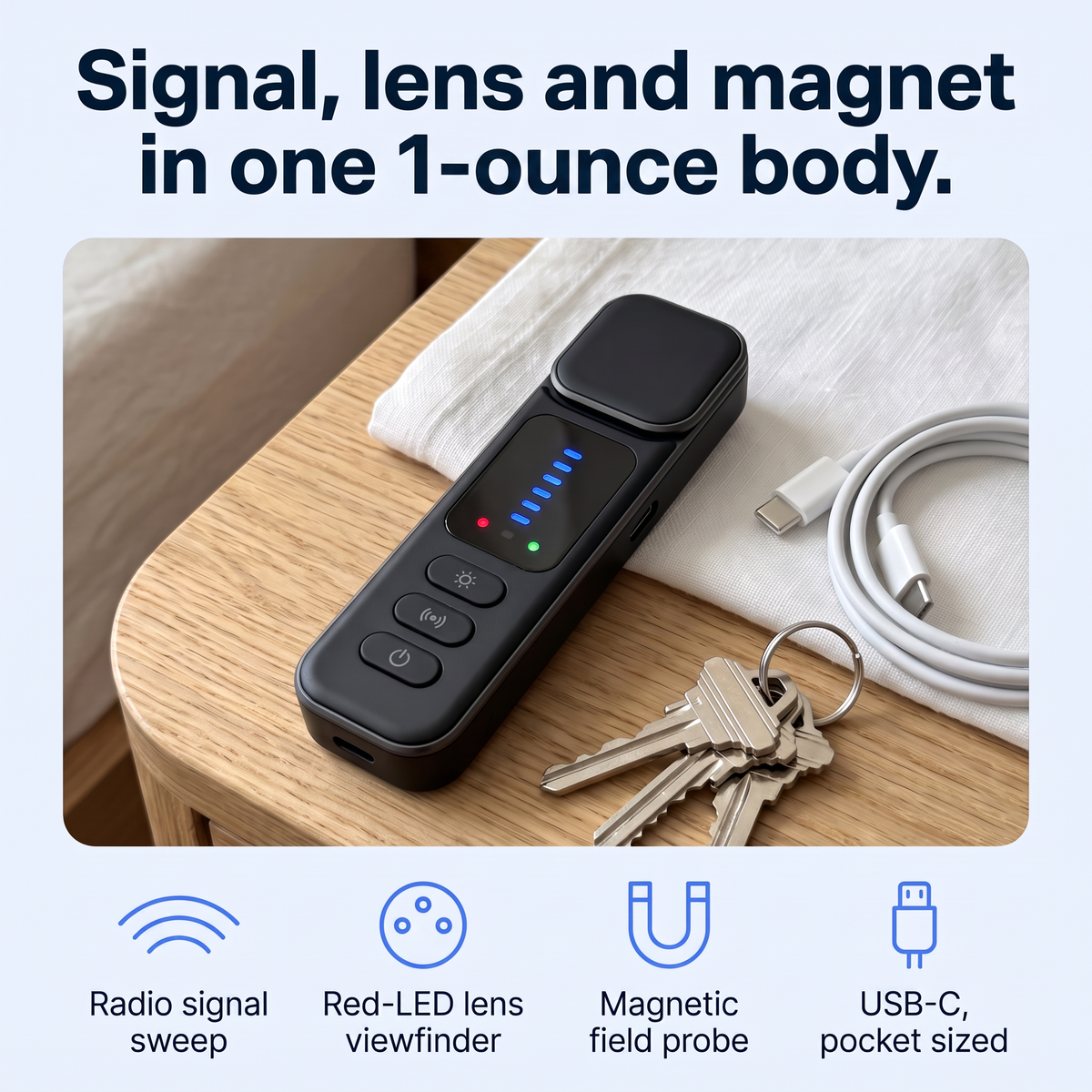
Privly™ — Hidden Camera, Microphone & Tracker Detector
🔴 Finds lenses, even switched off
⏱️ Full check in 4 minutes
🤫 Pocket-size and silent
- A four-minute check that ends
- A lens shows up even switched off
- Test it at home before you travel
- Nobody can certify an empty room
- You have to do all three passes
- 60 days to send it back either way
The problem isn’t the camera. It’s that the question never closes.
Millions of Americans now spend their nights in vacation rentals every year. We learned to sleep in strangers’ homes far faster than we learned how to check one. So you stand there at midnight looking at a smoke alarm, and twenty minutes later you still have no idea.
You don’t know when you’re allowed to stop
You check the alarm, then the plug, then the alarm again. There’s no finish line, so you keep going until you’re tired rather than until you’re sure. What’s missing isn’t equipment. It’s an order of operations with an end.
Everything you’ve tried was inconclusive
The WiFi scanner app returned two unnamed devices and no way to interpret them. The phone-camera trick showed nothing — modern sensors have infrared filters, and many pinhole cameras have no infrared LEDs anyway. Neither answer was an answer.
And you feel silly for asking
Your partner thinks you’re overthinking it. You don’t want to accuse a host who has done nothing wrong. So you say nothing, and you lie awake instead. Airbnb banned indoor security cameras in listings worldwide on April 30, 2024 — which tells you the question was reasonable enough to change the rules over.

The night the cameras went quiet
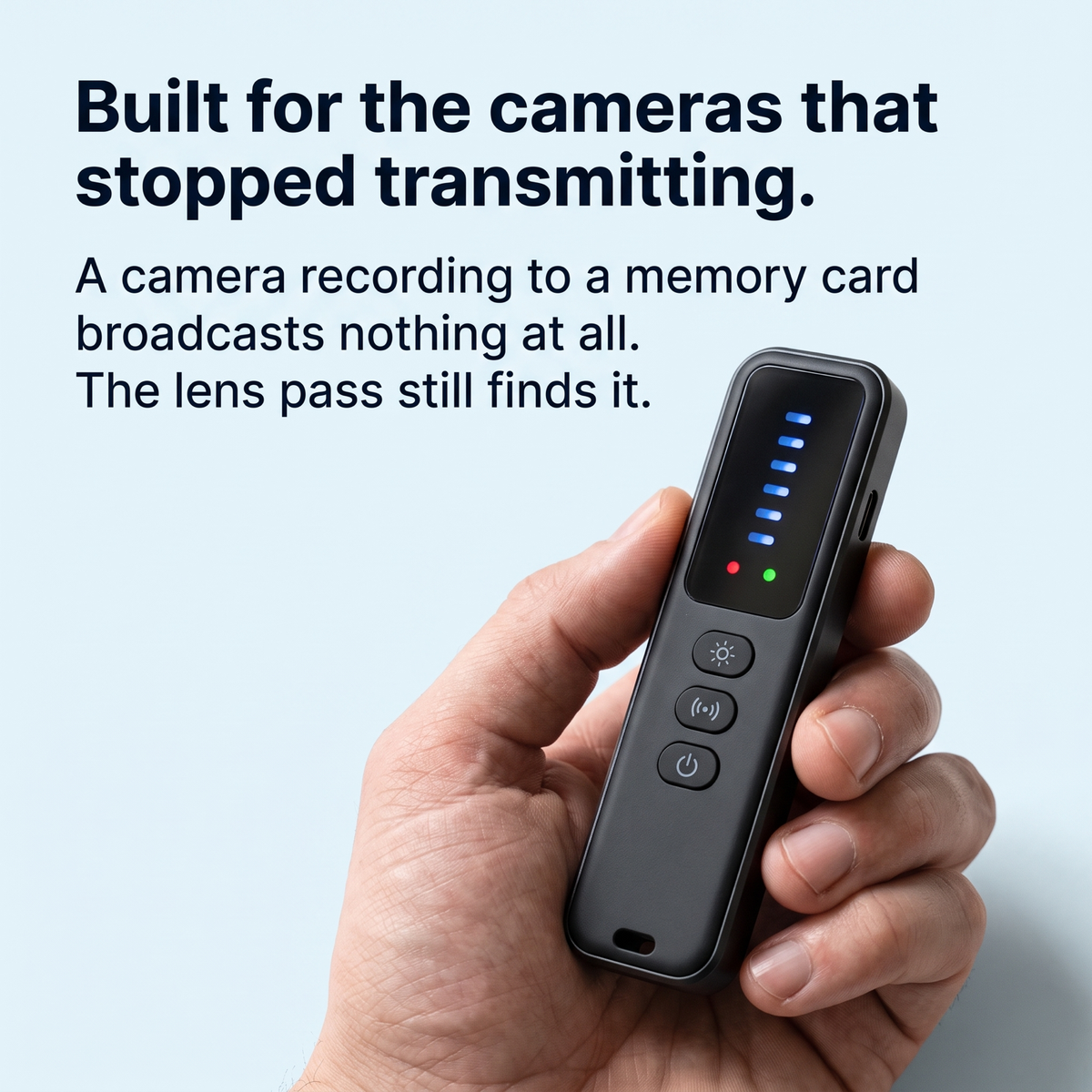
Until about ten years ago, a hidden camera had to send its picture somewhere to be any use. It gave itself away on the airwaves, and the little detector people took traveling was enough to find it.
Then memory cards got tiny and cheap, and cameras went quiet. A modern one simply saves the picture inside itself and waits for someone to come back for it. There is nothing to hear. No app can see it, no wifi scan will list it, and no signal detector on its own will ever tell you it’s there.
Nobody wrote to the people who’d already bought a detector to tell them it had gone half blind. That’s why so many reviews say “it finds nothing” — they were listening for a noise in a silent room.
It’s also why the wifi scanner app and the phone-camera trick left you exactly where you started: no more certain than before.
The 4-Minute Room Check
This is the part that matters, and it’s the reason people tell us they finally sleep. The device is just the instrument — the order is what makes the check end. Three passes, one for each thing a camera can’t all avoid at once. Do them in this order, and don’t skip the first one.
Quiet the room
Your own phones into airplane mode, smart watch off, and note where the wifi box is. Skip this and the device just reacts to you — which is the single reason most people conclude these things don’t work.
Listen
Walk the room slowly and let it tell you if anything nearby is switched on and sending. Set it to vibrate and nobody in the next room hears a thing.
Look — the one that counts
Lights off, look through the red viewfinder, and follow the lines of sight: from the bed, from the shower, from where you get changed. A lens shines straight back at you — even one that’s switched off.
Feel
Run it under the bedside drawers, and in a car under the body and inside both wheel wells. It picks up the magnet holding something in place, which is how these things actually turn up.
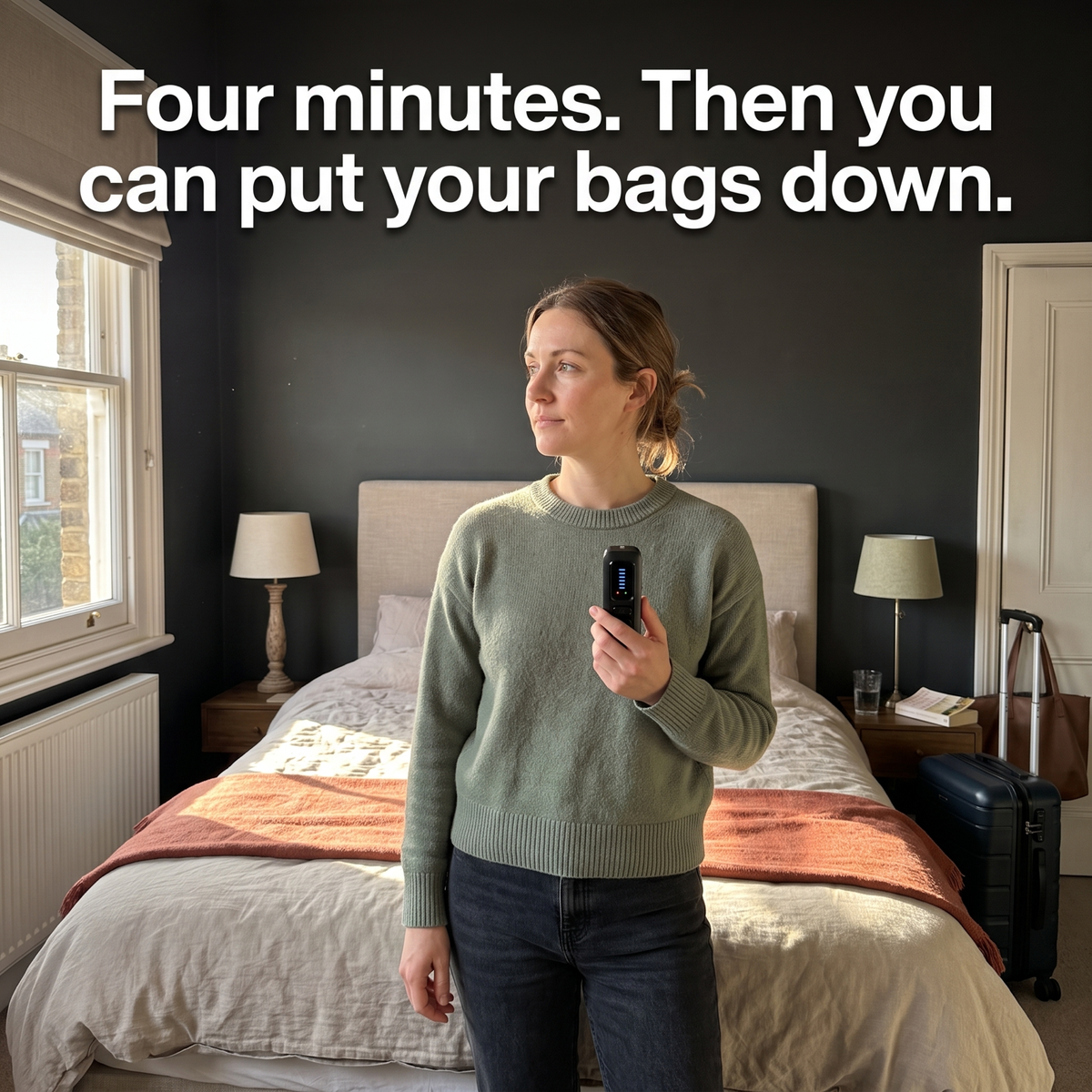
Then you stop. That’s the bit you’re really buying. Not a certificate that the room is empty — nobody can give you that — but a clear end to the question, so there’s nothing left to lie awake turning over. Four minutes, and the bags go down.

A camera can hide its signal. It cannot hide its lens.
Think of a cat’s eyes in your headlights, or a road sign lighting up from half a mile away. Some things send light straight back to whoever shines it — and a camera lens can’t help doing it.
That is its whole job: to gather light. So in a dark room, a lens answers a red light held next to your eye with a hard little wink. It does that whether the camera is on or off, recording or unplugged, connected to something or to nothing at all.
This is the check that professionals actually recommend to ordinary people, and it’s the reason the second pass exists. It’s also the one most people never do properly — because it only works with the lights off, moving slowly, following the lines of sight rather than sweeping the room at random. Done the right way it takes about ninety seconds.
One thing we’ll say plainly: glass and shiny trim wink back too. A wink isn’t a camera. It’s something to walk over and look at — five seconds, and nine times out of ten it’s a picture frame.


They tried Privly™
They finally slept

I’d checked the smoke alarm in three different Airbnbs and never once come away sure. Doing the passes in order was the difference — lights off, follow the sight lines from the bed, done. Found nothing, and this time that actually meant something.

Bought it after reading the honesty section, which is a strange reason to buy something. Everyone else was promising to find every camera on earth. These are the only people who told me what it wouldn’t do.

Did the at-home test first — aeroplane mode on and off, then walked it at the router. Watching it react to things I already knew about is what convinced me it wasn’t a plastic toy. Wouldn’t have trusted a quiet result otherwise.

Got it for my daughter’s first term in a private let. She thought I was fussing until she used it. It’s about the size of a marker pen and it doesn’t make her feel like she’s doing something odd.
Eight places worth pointing the viewfinder at
Professionals give the same advice to the public every time: work backwards from what a camera would want to see. The bed, the shower, the spot where you get changed. Draw the line from there to the wall, and check what’s sitting on it. These eight cover the vast majority of real cases.
Smoke & heat alarms
Ceiling-mounted, ignored by everyone, and pointed at the bed by design. The first thing to check and the thing people stare at longest without concluding.
USB chargers & plug adapters
Wall power, no battery to run down. Look for one that doesn’t match the others in the property, or one plugged in where nothing needs charging.
Air fresheners & diffusers
Reported cases have involved cameras concealed in plug-in air fresheners as well as smoke detectors. Plug-in devices in a bedroom are worth a second look.
Clock radios & speakers
Front-facing, at bed height, already full of electronics. Check the face of it under the lights-off pass.
Shelves, books, decorative boxes
Anything at eye level with a small gap or hole in the front, especially if it’s the only ornament on that wall.
Mirrors and glass
Check from an angle, lights off. Be aware glass and shiny trim also throw light back — which is exactly why you follow sight lines rather than sweeping at random.
Bathrooms — vents and shelves
The room people check last and the one that matters most. Extractor vents, shampoo shelves, and anything facing the shower.
The car
Wheel wells, under the chassis, inside the trunk lining. This is the magnet pass, and it takes thirty seconds.
Reported cases keep showing why the ordinary objects matter more than the exotic ones: smoke detectors, chargers, clocks, air fresheners. It is almost never a hole in the wall. It is nearly always something that was supposed to be there.

And if you do find something?
Almost nobody ever will. But part of what keeps people awake is not knowing what they’d do if they did — so here is the plan, and it’s three steps long.
1. Photograph it where it sits. One wide shot of the room, one close up.
2. Leave it alone. Don’t handle it, don’t unplug it. Put a towel over it if you’d rather.
3. Go, then report it. To the police, and to the platform or the property manager. Book somewhere else and let someone else deal with the property.
What we won’t tell you to do is knock on anyone’s door. You don’t know who you’re speaking to, you’re a guest in their building, and it isn’t your job to sort it out at one in the morning. Your job is to be somewhere else.
And if it turns out to be the wifi box, which it very nearly always is — that’s a good evening, not a wasted four minutes. You looked, you know you looked, and now you can stop.
Frequently Asked Questions
Is it legal to own and use?
Yes. Privly only listens and looks — it doesn’t send anything and it doesn’t interfere with anything. Detectors like this are sold openly in the U.S., and checking a room you’re sleeping in is generally your call to make. If you ever do find something, the sensible next step is the police and the platform rather than a conversation with your host.
It found nothing. Does that mean I’m safe?
It means you looked properly, in three different ways, and nothing answered. That’s the honest version — and it’s worth more than a false promise, because you can rely on it. Do the one-minute test at home first and a quiet result stops being a shrug: you’ll have watched it react to things you already knew were there, so you know it works. Nobody, at any price, can hand you a certificate that a room is empty. What you can have is the settled feeling of having checked, which is the thing that actually gets you to sleep.
Won’t it react to my own phone and the wifi?
It would — which is exactly why the first pass is switching your own things off. Phones in airplane mode, watch off, and note where the wifi box is, then start. Forty-five seconds. That one step is the difference between a device that seems to react to everything and one that tells you something. Almost nobody sells you this instruction, which is why so many people give up on these things. It’s the first line of ours.
Will I look ridiculous doing this?
No, and that matters more than people admit. It’s the size of a marker pen, so it lives in a coat pocket or the side of a case. It has a silent setting, so nobody in the next room hears anything. The main pass is done with the lights off, which is entirely unremarkable in a bedroom at night. And it arrives in plain packaging with discreet billing — nothing on the box announces what it is. Four minutes, and you’ve simply arrived.
Will it be dead when I actually need it?
Fair question — these things do spend months in a drawer between trips. Two answers. It charges on USB-C, so it takes the same cable as your phone and there’s no special charger to remember. And a check takes four minutes, so a single charge covers a great many trips. In practice: top it up the night before you go, the same way you’d charge your headphones. It’s covered by the 2-year warranty either way.
Will it help me check my car?
Yes, and here’s the honest version. If something under your car is switched on and sending while you’re checking, it’ll pick it up — but a lot of them only wake up now and then, so it’s worth going round the car twice with a gap in between. The magnet pass is the one that really earns its keep: it finds the magnet holding something in place, which is exactly how these things turn up in the real world. Thirty seconds around the wheel wells and under the body, and you’ve looked.